Trionyx / Ahmedabad, Gujarat, India

Full stack development for connected business products.

Build the web experience, business logic and data layer as one product. Trionyx develops full stack applications for teams that need more than a standalone website: operational dashboards, SaaS workflows and mobile-connected backends.

A focused brief. A scoped proposal. Clear next steps.

01 / A useful starting point

Built around the work
you need to get done.

For founders planning a software product and businesses replacing fragmented workflows. Start with the people, records and decisions your system needs to connect; the framework follows the requirements.

01

Web apps & operational dashboards

Create a web workspace around the tasks your users need to complete. We scope roles, navigation, forms, data views and loading or error states. React and Next.js are useful building blocks; the product still needs clear business rules and a manageable first release.

02

APIs, databases & integrations

Connect interfaces to a backend with defined data models and integration boundaries. Node.js, TypeScript and PostgreSQL appear in our showcased projects. We review existing APIs, access requirements, record ownership and failure handling before committing to an integration.

03

Business workflows & SaaS products

Plan connected processes such as job scheduling, reports, quotations, invoicing and administration. Role-based access, audit requirements and account boundaries need to be designed for the actual product. A feature list becomes more useful when it follows an end-to-end workflow.

04

Mobile-connected platforms

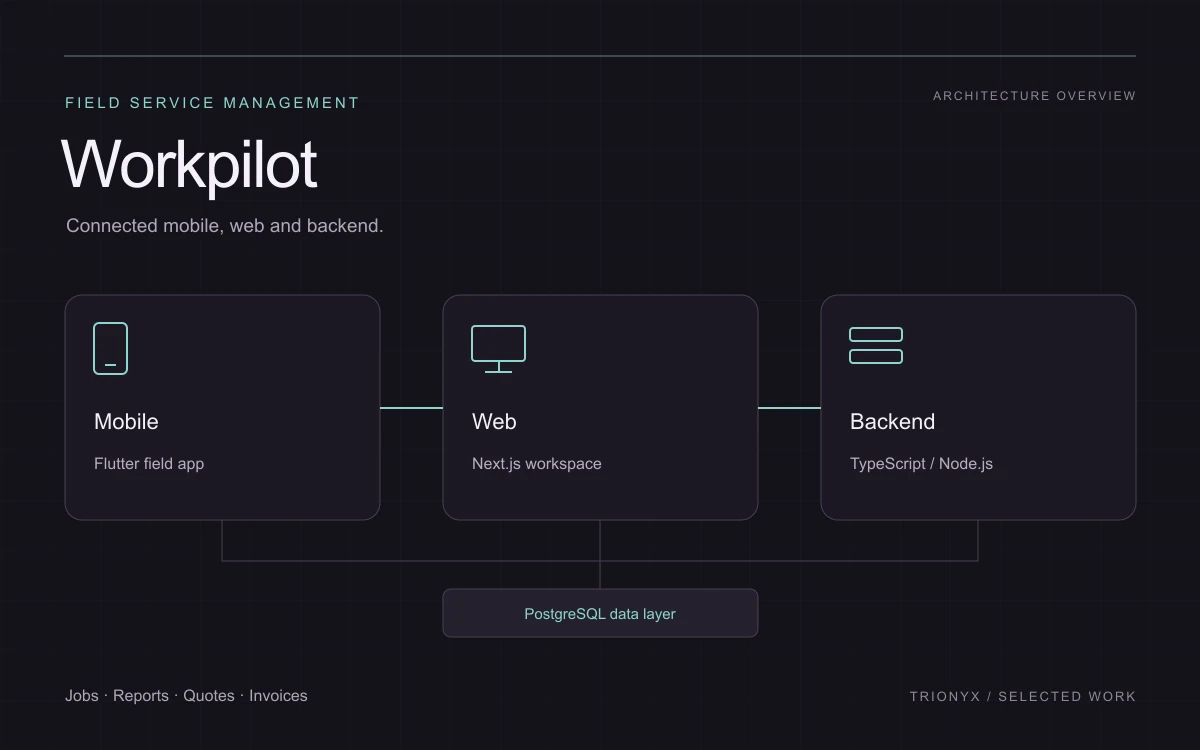
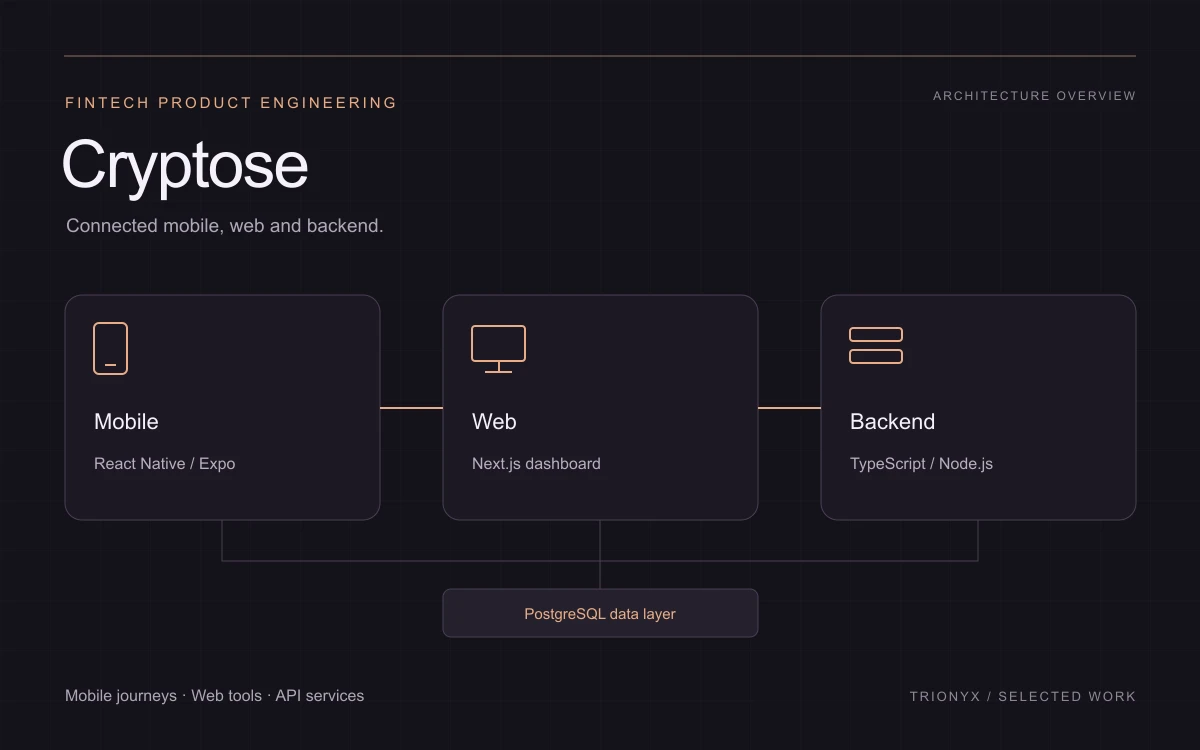
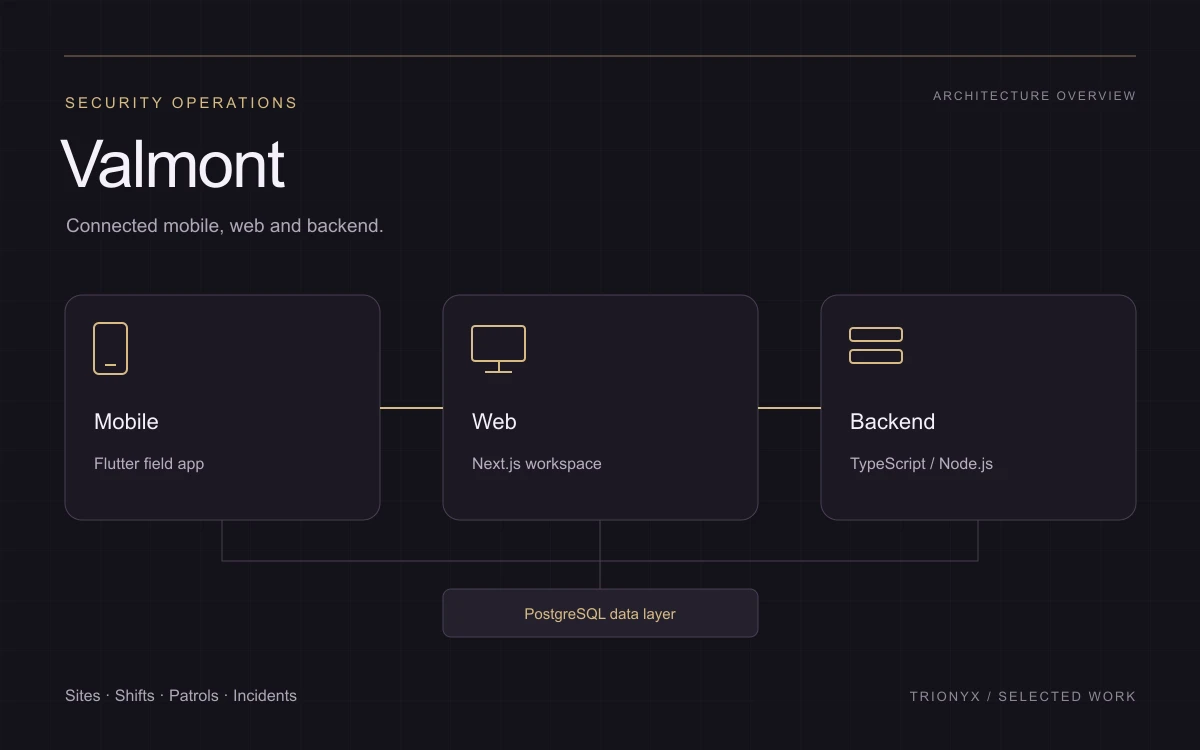
A field app and a dashboard often need different interfaces over a shared backend. Valmont and Workpilot illustrate Flutter-connected platforms; Cryptose uses React Native/Expo. We discuss mobile requirements alongside the web and API scope so the product works as a connected system.

02 / From discussion to delivery

A clear process.
An agreed handover.

What we scope together

  • A scoped workflow and feature plan with acceptance criteria.
  • Web interface and backend components specified in the proposal.
  • Data models and integrations within the agreed scope.
  • Testing and release preparation for the target environments.
  • Source, configuration guidance and an agreed ownership handover.
  1. 01

    Map the product

    Describe your users, current workflow, essential records and the first useful outcome. Identify existing systems and who can authorize access before planning integrations.

  2. 02

    Define the boundaries

    Agree interface journeys, business rules, roles, data ownership and external dependencies. Separate the first release from future modules so the proposal has clear acceptance criteria.

  3. 03

    Build connected slices

    Review a complete journey across interface, API and data rather than treating each layer as a separate finished product. Test permission boundaries, validation, expected failures and recovery paths.

  4. 04

    Release & hand over

    Prepare deployment, environment configuration and operational guidance. Agree monitoring, maintenance responsibilities and change requests as part of the delivery and support scope.

03 / Explore the work

Relevant project examples.

Start with the features and workflows in our portfolio. We can discuss the delivery context and how a similar approach might fit your brief.

Valmont application architecture illustration

Portfolio / Project overview

Valmont

A Flutter field application connected to a Next.js security operations dashboard and Node.js backend. Explore site, shift, patrol and reporting workflows.

Workpilot application architecture illustration

Portfolio / Project overview

Workpilot

Field service management spanning a Flutter app, web workspace, scheduling, documents, quotations and invoicing.

Cryptose application architecture illustration

Portfolio / Project overview

Cryptose

A product development showcase connecting React Native/Expo mobile experiences, Next.js operational tools and a TypeScript backend.

04 / Know what you are buying

Scope first.
Then a useful estimate.

How to scope a full stack application

Prepare a practical brief covering roles, workflows, APIs, data and release responsibilities.

The estimate follows the system boundaries

Roles, modules, integrations, document generation, migration and infrastructure requirements all affect cost. An existing backend may save work or introduce constraints. The proposal should separate development from hosting, subscriptions and ongoing support.

Choose the stack around the product

Technology choices need to fit the team, operating environment and integration requirements. We use project examples to explain the architecture, without treating a particular framework as a guarantee of scale, security or commercial success.

05 / Before we talk

Good questions.
Straight answers.

What does full stack development include?

It connects the user interface, server-side business logic and data layer. The actual scope may also include authentication, integrations, administration and deployment. The proposal should identify which parts are included.

Can you build both a mobile app and web dashboard?

Yes, these can be scoped as connected parts of one product. Valmont and Workpilot are Flutter examples; Cryptose uses React Native/Expo. Mobile features, dashboard roles and shared APIs need their own acceptance criteria.

Can you improve our existing application?

We can discuss existing interfaces, APIs and databases. Code access, documentation, dependencies and migration requirements need review before confirming effort or a release plan.

How much does a full stack application cost?

There is no useful universal price. Modules, user roles, integrations, migration, reporting and support requirements affect the estimate. Share your budget range and the first workflow you need so we can discuss an appropriate scope.

Who owns the code and hosting accounts?

Agree source-code access, intellectual-property terms, hosting and third-party account ownership in the written contract. The handover and support scope should make ongoing responsibilities clear.

Your next step

What should your web app and backend make possible?

Send a short brief. We will review the goal, clarify the scope and discuss the next step with you. No credentials or confidential customer data are needed for an initial conversation.

Also exploring a Flutter mobile app? See our Flutter development service.